
How to Disable windows update in Windows 10

Disable windows update in Windows 10 - Btw, windows 10 was realesed, it looks nicer. By the design and management memory, windows 10 is more better than more windows. But I think windows 10 more looks like  a not Operating System, but it looks a online service.

Windows 10 makes my internet quota was quickly exhausted. Why not? every time windows 10 updating in automatically. Very very not good for some people like me. :D. And that makes me sad, in Windows 10 can't turned off easily. So, Paper 4Share will share how to disable windows update in Windows 10.

Step by step to disable windows update in windows 10

Open services tools, how we do it? type services in the search box, and than choose the Services. Look at below.

Disable windows update in Windows 10


After it, you will look a Services window. And than find and open (by double clicks) a windows update.
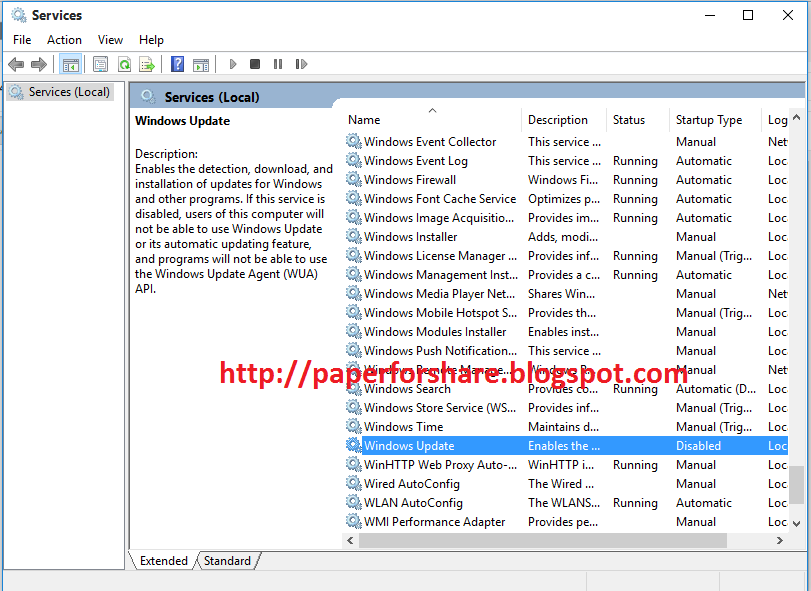
Disable windows update in Windows 10


In the Windows Update Properties window, Change the startup type to "Disabled", Click stop button. Than click Apply button. And click "OK".


Finish, now your windows update service has stopped. To check the service, you can follow this article.

Open Windows PowerShell. Using the search box, type powershell. Choose and open Windows PowerShell.

Type and ENTER this commad:
get-wmiobject win32_service –filter "name='wuauserv'"
if the results is like below, so your windows update service has stopped.


I hope this useful, and you can leave a comment if you have a problems. Thanks for your visit.

Paper 4Share - How to Disable windows update in Windows 10

Comments

Popular posts from this blog

How to Install CloudSim in Ubuntu (in 3 easy steps)

The contents of this DIY has been tested on Ubuntu 12.04 LTS x64 with CloudSim 3.0.3 beta and JDK8u11 x64. It should work similarly on other distros of Ubuntu and for different version of JDK as long as you use Java version 1.5 or newer. The text shown in RED in the DIY represents the values that will differ depending upon your JDK version and locations. CloudSim is a framework for modelling and simulating cloud computing infrastructure and services. In this DIY we will see how to install CloudSim in Windows easily and efficiently. A more detailed description, APIs and research papers related to CloudSim can be found here . Let us begin. Step 1: Setting up the Prerequisites 1. First of all we need to download the CloudSim and latest version of the Java Development Toolkit (JDK). CloudSim can be found here . 2. CloudSim requires a working Java installation. So, open up a terminal and run the following 1 sudo add-apt-repository ppa:webupd8team/java 2 sudo apt-get...

6 Url Shorteners Yang Menghasilkan Uang Selain AdF.ly

Salam sobat GBX nah di pertemuan kita kali ini ane akan membahas 6 Url Shorteners Yang Menghasilkan Uang Selain AdF.ly seperti yang anda tau adf.ly adalah url shortener terbaik yang membayar kita karena telah menggunakan jasannya, tapi selain adf.ly ternyata masih banyak lagi Url Shorteners Yang Menghasilkan Uang, sekarang kita lihat saja ulasan di bawah.  6 Url Shorteners Yang Menghasilkan Uang Selain AdF.ly 1. Adfly adf.ly Yup yang ini memang patut diletakkan di peringkat satu ya, Adfly sudah ada dan terpercaya sejak bertahu-tahun lalu dan sudah menjadi pemendek link / url terbaik selama ini.  Selain menyediakan fasilitas penyingkat url, adfly juga merupakan situs penghasil dollar yang sudah sangat terkenal (melalui Pay Per Click dan Referal). Banyak juga teman-teman di internet yang sudah sukses mendapatkan dollar lho. (adfly ini sudah terpercaya dan ya semoga terus aman begitu dech). Komisi yang telah anda dapatkan dari adfly ini bisa langsung di transfer ke pay...

How To Add or Remove System Icons From The Kali Linux Desktop

When Kali Linux is started, there are always one or more system icons on the desktop. “Computer” is usually a default icon. However, some people might like to remove this icon and/or add other icons like the famous “Trash” icon. All the other tutorials will tell you to use the Linux, “gconfig-editor,” but Kali Linux does not have this system editor! I believe I am the only one who knows of a way to do this, so let me share my knowledge in this simple tutorial. Step one: Start and login to Kali Linux using your account or the “root” account. Step two: Open the main menu. Hover your mouse on “System Tools,” and click on “dconf Editor.” After a few seconds, the dconf Editor will open. Now all you have to do is browse to the correct category and set the options. Step three: When the dconf Editor window opens, click on the plus sign next to “org” (located in the left pane). Step four: Now click the plus sign next to “gnome.” Step five: Scroll down the list in the left pan...